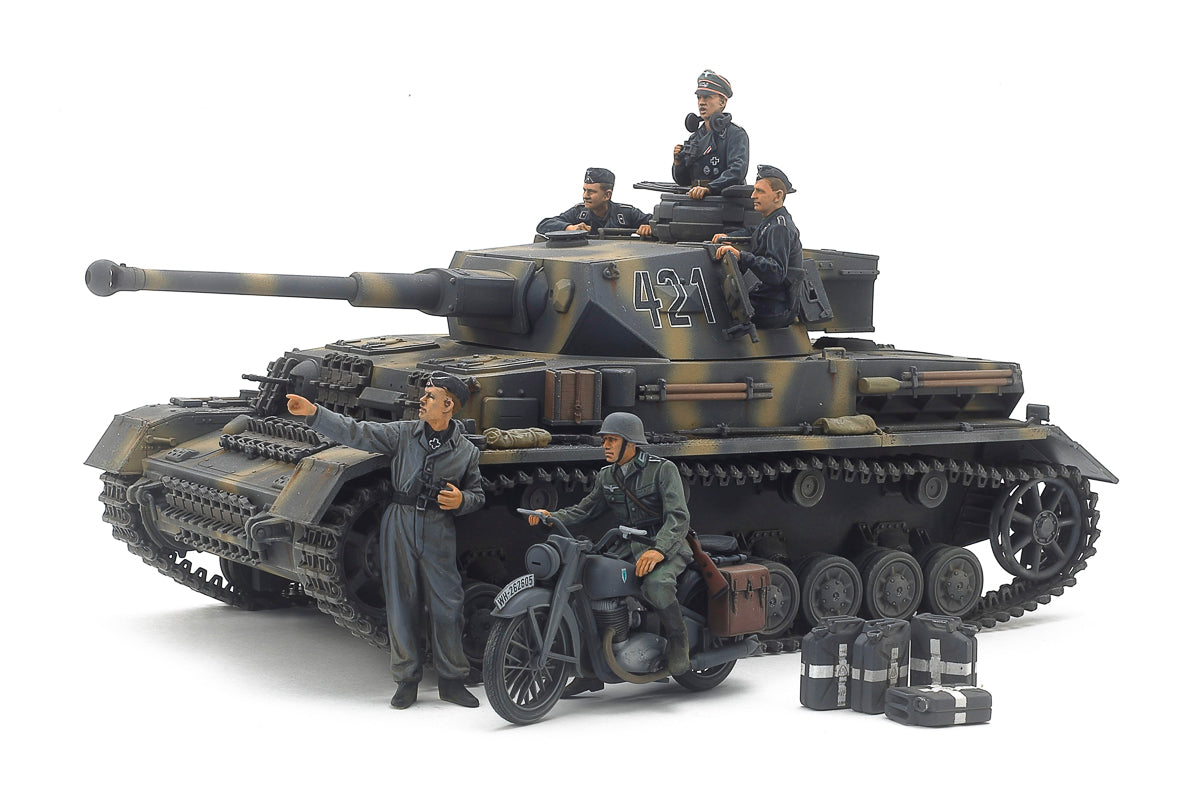
1/35 German Tank Panzerkampfwagen IV Ausf.G Early
Tilgængelighed for afhentning kunne ikke indlæses
- Hurtig levering
- 30 dages returret
- Dansk kundeservice
- Sikker betaling
-
Leverandør:
WITTMAX
-
Type:
Plastikbyggesæt
- Tags: 1:35, Militær (til lands), Plastikbyggesæt, Vestergaard, Wittmax
Om produktet
1/35 German Tank Panzerkampfwagen IV Ausf.G Early Production & Motorcycle Set
Tamiya is delighted to release the 1/35 German Tank Panzerkampfwagen IV Ausf.G Early Production & Motorcycle Set 'Eastern Front' which features tank parts from Item 35378, three figures from Item 35374 and new decals, plus two figures and motorcycle from Item 35307.
Throughout WWII, the Pz.Kpfw.IV was the main battle tank for the German Army, and its Ausf.G was the first variant (produced from March 1942 and June 1943), which utilized a long-barreled gun. It was in service at the Eastern Front, and it countered overpowering Russian tanks such as the T-34 and KV-1.
About the Model
• This is a 1/35 scale plastic model assembly kit.
• The powerful form equipped with the L/43 7.5cm KwK40 gun (from Item 35378 1/35 German Tank Panzerkampfwagen IV Ausf.G (Early Production)) is faithfully captured in style.
• Includes three figures from Item 35374 1/35 German Tank Panzerkampfwagen IV Ausf.F, two (motorcycle rider and standing officer) figures and motorcycle from Item 35307 1/35 German Heavy Tank Destroyer Jagdtiger Mid Production Commander Otto Carius. (All five figures feature Eastern Front uniforms.)
• New decals recreate two Eastern Front vehicles.
• Comes with new instruction manual and painting guide.
About the real German Tank Panzerkampfwagen IV Ausf.G Early Production
The Panzerkampfwagen IV, often abbreviated as Panzer IV, was one of the most iconic German tanks of World War II. The 'Ausf.G' refers to a specific variant or model within the Panzer IV series, and 'Early Production' denotes the timeframe of its manufacturing.
Here are some key features and characteristics of the Panzerkampfwagen IV Ausf.G Early Production:
Introduction and Production: The Ausf.G variant was introduced in 1942 and was produced until 1943. It was one of the most produced variants of the Panzer IV series.
Armor: The Ausf.G featured armor plating that varied in thickness, with frontal armor typically ranging from 50 to 80 millimeters thick, offering good protection against many anti-tank weapons of its time.
Armament: Its main armament was the 75mm KwK 40 L/43 or L/48 gun, which was effective against most Allied tanks it encountered during the early to mid-stages of World War II. It also had two 7.92 mm MG 34 machine guns for secondary armament, typically mounted in a coaxial position with the main gun and in a hull-mounted position.
Mobility: The Panzer IV Ausf.G was powered by a Maybach HL 120 TRM engine, which provided it with a top speed of around 38 km/h (24 mph) and a range of approximately 200 kilometers (120 miles) on roads. Its mobility was considered decent for its time, although it was outclassed by some later Allied tanks.
Crew and Interior: The tank typically had a crew of five: commander, gunner, loader, driver, and radio operator/machine gunner. The interior layout was relatively spacious compared to some other tanks of its era, providing a relatively comfortable working environment for the crew.
Tactical Use: The Panzer IV Ausf.G was primarily used as a main battle tank in the German armored divisions. It saw action on both the Eastern and Western Fronts of World War II, participating in various major battles such as the Battle of Kursk and the Battle of Normandy.
Modifications: Throughout its production run, the Panzer IV underwent numerous modifications and upgrades to improve its effectiveness and address shortcomings. These modifications included changes to the armor layout, upgrades to the main gun, and improvements in engine performance.
Overall, the Panzer IV Ausf.G Early Production was a significant and versatile tank in the German arsenal during World War II, playing a crucial role in armored warfare on both the Eastern and Western Fronts. Its combination of firepower, armor, and mobility made it a formidable opponent against Allied tanks of its time.